
silver jewelry wholesale gem options
Wholesale jewelry, as the name suggests, is designed, configured, and crafted to meet the requirements of a mass market. Kaisilver explains that lower to medium grades of silver weight, craftsmanship, and gemstones are often acceptable when manufacturing jewelry for price-sensitive markets. Gemstones remain an important component of most jewelry, and wholesale silver jewelry is no exception. Gems deliver color and sparkle to jewelry, it is not uncommon for jewelry lovers to select gems based on traditional customs and beliefs. While Kaisilver is better known for its fine custom made jewelry, we can guide you on issues related to gems and jewelry in generally,
The selection of stones influences the appearance, production cost, and final selling price of each piece. Understanding the available options helps explain how manufacturers configure gemstones for wholesale jewelry across different market segments. Our team of experts at sales@kaisilver.com will gladly share their expertise without, expecting you to make any purchase from us.
GOLD JEWELRY: Given the volatility in gold prices, the Kaisilver team will re-calculate all gold jewelry prices, at the time that we receive your query. Please keep this in mind when you refer to the price tables, displayed on our product pages. The updated price will be sent to you the moment, we get your query with details of the item that interests you.
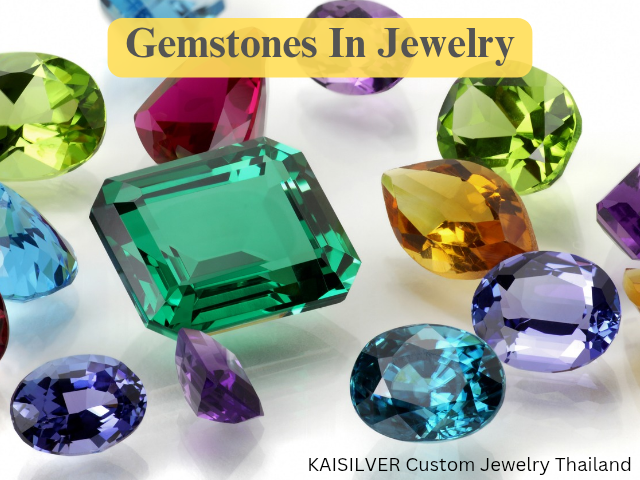
IMITATION GEMS
At the basic level, gemstones used in jewelry can be classified as natural or factory-made materials. Factory-made stones include imitation gems, which may resemble natural gemstones primarily through their color and general appearance. However, their chemical composition does not match that of the natural gemstones they imitate.
Kaisilver notes that these materials provide an economical option for manufacturers targeting very low production costs. Consequently, the gemstone component of wholesale silver jewelry incorporating imitation stones can represent a relatively small proportion of the overall manufacturing expense. Their suitability depends on the desired appearance, intended market, and expectations of the end customer. Wholesale jewelry crafted with cheap imitation gems, can appear attractive to jewelry buyers who are not very particular about getting natural gemstones.
NATURAL GEMS
Natural gemstones occur in a wide range of qualities, with color, clarity, and cutting quality influencing their appearance and commercial grade. When budget pricing is important, manufacturers can select suitable lower-grade natural stones to meet production targets. The choice of gemstones for wholesale jewelry therefore depends on balancing appearance, availability, and cost.
Still on natural gems, the use of unconventional gemstone treatments on some low grade natural gems, can make them appear gorgeous. Examples are blue sapphires and rubies, treated by the ‘glass filling’ or ‘fissure filling’ process. These gems can appear very valuable to the untrained eye. TV channels in the US often rely on these gems to make wholesale silver jewelry with natural rubies and sapphires. The problem is that such treatments, drastically reduce the value and durability of the gems. In all fairness jewelers selling jewelry with these gems, should provide a clear and complete explanation to buyers.
LAB GROWN GEMS
Another category comprises laboratory-grown or synthetic gemstones. Unlike imitation stones, these materials are produced to replicate the physical, chemical, and optical properties of their natural counterparts. Synthetic rubies, sapphires, and emeralds are familiar examples. Some laboratory-grown emeralds also display inclusions and fissures resembling features commonly observed in natural emeralds. Kaisilver explains that synthetic gemstones generally cost more than basic imitation materials because their composition and properties are comparable to those of natural gems. Their selection as gemstones for wholesale jewelry depends on the required specifications and available budget. One advantage of using lab gems for wholesale jewelry is that, they can deliver a very similar appearance across a large number of pieces.
DIAMOND OPTIONS
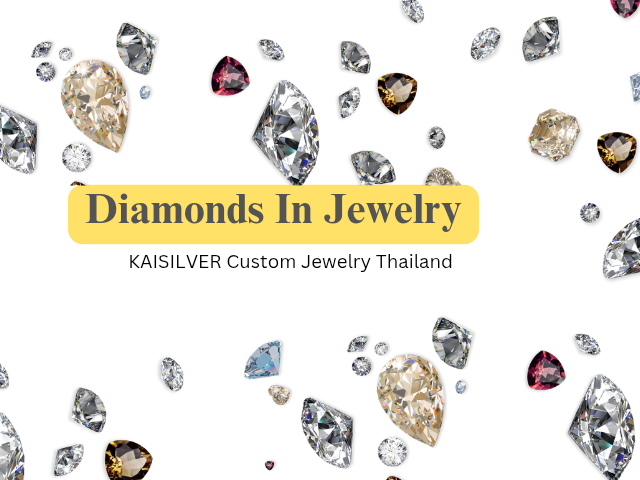
Lab-grown diamonds have attracted considerable attention in recent years because they replicate the essential properties of natural diamonds. Distinguishing between them reliably requires appropriate gemological testing and equipment. Natural diamonds are less common in wholesale silver jewelry, where lower-grade stones may be selected when natural diamonds are required within a restricted budget.
Although laboratory-grown diamond prices have declined substantially in recent years, their cost can still exceed the targets established for many mass-market products. Kaisilver has encountered clients selecting lab-grown diamonds for wholesale jewelry when the required stones measure approximately 1mm or less.
More economical alternatives for achieving a diamond-like appearance for wholesale silver jewelry, include cubic zirconia (CZ) and moissanite. Both are factory-produced materials that offer attractive brilliance at comparatively accessible prices. They are also available in various colors, allowing manufacturers to create different visual effects.
SUMMARY
The selection of gemstones for wholesale jewelry ultimately depends on the targeted selling price, manufacturing costs, and required profit margins. Imitation stones, natural gemstones of different grades, laboratory-grown gems, lab-grown diamonds, cubic zirconia, and moissanite each serve different purposes. Kaisilver emphasizes that wholesale silver jewelry can be produced across a broad range of price points, with gemstone selection reflecting the intended customer base and product specifications. Understanding these distinctions provides a clearer picture of how gemstone choices influence the economics and appearance of mass-market jewelry.